
What Went Wrong with Terra Luna
What you'll learn in this Analysis
How the Terra Luna ecosystem worked
Why it grew so fast
The exact mechanism behind its collapse
Key lessons about stablecoins and systemic risk
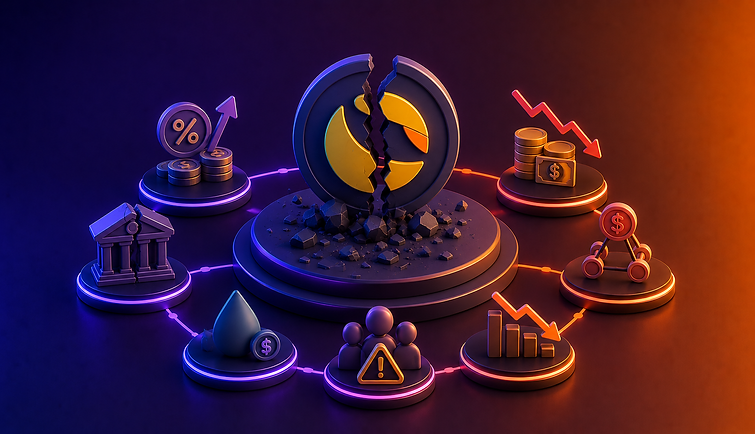
1. The Rise of Terra
Terra Luna was once one of the largest ecosystems in crypto.
At Its Peak:
$60B+ market value
Massive DeFi ecosystem
One of the top stablecoins
👉 Its core promise:
🪙 A decentralized stablecoin without collateral
Key Insight
Terra didn’t fail because of a bug. It failed because of its design.
2. How Terra Actually Worked
Core Components:
UST → Stablecoin (target = $1)
LUNA → Volatile token
The Mechanism:
To keep UST at $1:
1 UST could be swapped for $1 worth of LUNA
If UST > $1 → mint more UST
If UST < $1 → burn UST, mint LUNA
👉 This was meant to maintain the peg
Core Relation
1 UST ↔ $1 worth of LUNA
👉 This simple rule powered the entire system
3. Why Terra Grew So Fast
1. High Yield (Anchor Protocol)
~20% APY on UST deposits
Attracted massive capital
👉 Users saw it as “safe yield”
2. Easy Narrative
Stablecoin + high yield
Simple and attractive
3. Strong Ecosystem Growth
DeFi apps built on Terra
Rapid adoption
👉 Growth accelerated quickly
4. The Core Problem
The system depended on:
Continuous demand for UST
Reality:
No real revenue
Yield was subsidized
Demand was artificial
👉 This created fragility
5. The Collapse (Step-by-Step)
Phase 1: Selling Pressure
Large UST withdrawals
Confidence weakens
Phase 2: UST Depegs
UST falls below $1
Panic begins
Phase 3: LUNA Minting Explosion
System tries to restore peg
Massive LUNA minted
👉 Supply explodes
Phase 4: Death Spiral
LUNA price crashes
Confidence collapses
More selling
👉 Feedback loop accelerates
6. The Death Spiral Explained
Core Loop:
UST loses peg
More LUNA is minted
LUNA price drops
Confidence decreases
More UST is sold
👉 Repeat until collapse
7. The Fundamental Flaw
Terra tried to create stability without real backing
Problem:
UST was not backed by assets
Only by market confidence
👉 When confidence breaks:→ system collapses
8. Key Lessons from Terra
Lesson 1
High yield without revenue is unsustainable
Lesson 2
Algorithmic stability ≠ real stability
Lesson 3
Confidence-based systems are fragile
Lesson 4
Liquidity crises happen fast
9. Warning Signs Before Collapse
Red Flags
Unrealistic APY (~20%)
Rapid growth
Dependence on new capital
No real collateral
👉 These signals were visible
10. Real Insight (Critical)
Stability must come from real backing or real demand
👉 Without it:
Systems rely on belief
Belief can break instantly
Final Takeaway
Terra Luna failed because:
❌ No real collateral
❌ Unsustainable yield
❌ Fragile design
Successful systems require:
✅ Real backing
✅ Sustainable economics
✅ Strong demand
👉 The real question:
“What supports the system when things go wrong?”


