
How MetaMask Became the Default Web3 Wallet
What you'll learn in this Analysis
How MetaMask became the most widely used Web3 wallet
The key factors behind its dominance
Why competitors struggled to replace it
Lessons about distribution, UX, and ecosystem integration
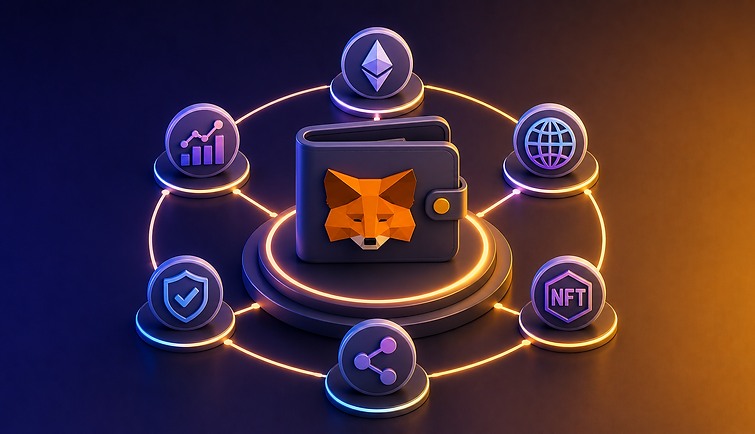
1. What is MetaMask?
MetaMask is a browser-based crypto wallet that allows users to:
Store digital assets
Connect to dApps
Interact with DeFi protocols
👉 But its real role is deeper:
🧠 MetaMask is the gateway to Web3
Key Insight
MetaMask didn’t just build a wallet. It became the default interface for interacting with Web3.
2. The Timing Advantage
Early Positioning
MetaMask launched when:
DeFi was emerging
Ethereum ecosystem was growing
Few alternatives existed
👉 This allowed it to:
Capture early users
Integrate with early protocols
Build initial network effects
Result:
First wallet users installed → became long-term users
3. The Distribution Advantage
Browser Extension Model
MetaMask made a critical decision:
Become a browser extension
👉 Why this mattered:
Easy installation
Always accessible
Seamless dApp connection
Outcome:
It lived where users already were → browsers
4. Key Factors Behind Its Dominance
1. Deep Ecosystem Integration
MetaMask integrated with:
Uniswap
Aave
👉 Almost every dApp supported it
👉 Became the default connection option
2. Simplicity for Beginners
Easy setup
Clear interface
Straightforward wallet management
👉 Lower barrier to entry
3. First-Mover Network Effects
More users → more integrations
More integrations → more users
👉 Self-reinforcing loop
4. Developer Adoption
Developers built for MetaMask because:
It had users
It was widely supported
👉 Became standard infrastructure
5. Multi-Chain Expansion
Initially Ethereum
Later expanded to EVM chains
👉 Increased usability
5. The Default Effect
What happened over time:
Users defaulted to MetaMask
Developers integrated MetaMask first
👉 This created:
A standard layer in Web3
6. Why Competitors Struggled
Even better wallets faced challenges:
Problems:
No distribution
No integrations
No network effect
👉 Even with better UX → hard to replace MetaMask
7. Weaknesses of MetaMask
Known Issues:
1. UX Limitations
Not beginner-perfect
2. Security Risks
Phishing vulnerabilities
3. Complexity for Advanced Users
👉 Opened space for competitors
8. Key Lessons from MetaMask
Lesson 1
Distribution matters more than features
Lesson 2
Being the default creates dominance
Lesson 3
Ecosystem integration is everything
Lesson 4
Early adoption creates long-term advantage
9. Operator Framework
When evaluating Web3 tools, ask:
1. Is it widely integrated?
2. Does it have strong distribution?
3. Is it the default choice?
4. Are users locked into the ecosystem?
👉 These determine dominance
10. Real Insight (Critical)
The most powerful position in Web3 is being the default interface
👉 Because:
Users don’t switch easily
Developers build around it
Final Takeaway
MetaMask became dominant because of:
✅ Early timing
✅ Strong distribution
✅ Deep integrations
✅ Network effects
👉 The real reason:
It became the gateway to Web3


